
The thermal conversion of oily sludge through pyrolysis reveals complex transformations at both structural and chemical levels. Oily sludge, a hazardous by-product of petroleum refining and storage, is characterized by high hydrocarbon content, residual heavy metals, and stable colloidal matrices. When subjected to elevated temperatures in an oxygen-deprived environment, these matrices undergo decomposition, producing char, condensable oil, and combustible gases. Microscopic examination of this process highlights how an thermal desorption unit can unlock resource recovery while mitigating environmental burdens.
Structural Reorganization of Hydrocarbon Matrix
At the microscopic scale, oily sludge displays a dense and irregular morphology dominated by agglomerated hydrocarbon droplets and fine mineral particles. With progressive heating, phase separation occurs as lighter hydrocarbons volatilize, leaving behind an enriched carbon skeleton. The once homogeneous sludge fractures into porous char fragments, marked by fissures and voids created by vapor release. Scanning electron micrographs often reveal an evolution from smooth, compact structures to irregular porous surfaces, indicating enhanced surface area suitable for subsequent utilization.
Thermal Degradation Pathways
The decomposition of oily sludge progresses in multiple thermal stages. Initial heating expels moisture and volatile light hydrocarbons. As the temperature rises, aliphatic hydrocarbons degrade into smaller molecular fractions, while polycyclic aromatic hydrocarbons undergo partial cracking. The mineral fraction, largely consisting of silicates and metal oxides, remains structurally stable but embeds within the carbon matrix. This heterogeneous breakdown yields three principal outputs: a solid char enriched with fixed carbon, a complex mixture of pyrolysis oil containing valuable hydrocarbons, and syngas that provides intrinsic energy for the process.
Characteristics of Solid Residue
The solid residue obtained from oily sludge pyrolysis exhibits unique microstructural features. It retains traces of embedded metal oxides, which influence surface chemistry. Pore networks formed during volatile release increase the adsorption potential of the char, making it viable for use in environmental applications such as heavy metal capture. From a materials perspective, the microtexture of this residue suggests potential as a precursor for engineered carbon materials, provided post-treatment steps such as activation are performed.
Interactions Between Gas and Solid Phase
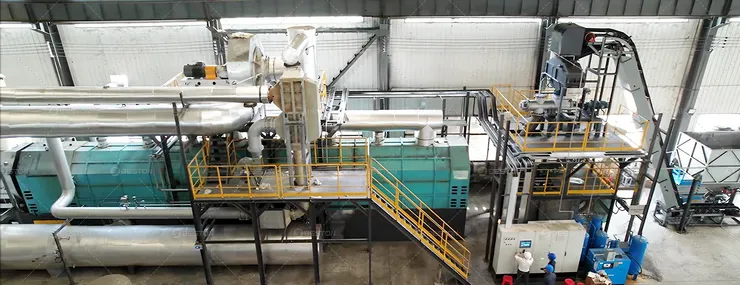
During pyrolysis, volatile hydrocarbons migrate through the solid matrix, generating internal pressure and shaping pore development. These interactions create intricate microchannels that not only increase surface complexity but also regulate heat and mass transfer within the system. In an oil sludge treatment plant, these dynamics are pivotal for optimizing energy recovery, as syngas can be recirculated for process heating, reducing external fuel demand. The balance between char stabilization and gas release defines overall efficiency and influences downstream recovery strategies.
Analytical Techniques for Micro-Scale Evaluation
To elucidate the micro-level transformations of oily sludge, a suite of analytical methods is applied. Scanning electron microscopy (SEM) illustrates morphological changes in char surfaces. Fourier-transform infrared spectroscopy (FTIR) provides information on functional group degradation, particularly the breakdown of aliphatic and aromatic hydrocarbons. Thermogravimetric analysis (TGA) tracks mass loss across temperature ranges, while X-ray diffraction (XRD) identifies crystalline residues within the char. Together, these methods yield a comprehensive portrait of how thermal decomposition reshapes the sludge matrix.
Environmental and Industrial Relevance
The microscopic attributes of oily sludge pyrolysis products translate into significant environmental and industrial value. The conversion process reduces hazardous hydrocarbon content, stabilizes heavy metals within a carbon framework, and minimizes sludge volume requiring disposal. Pyrolysis oil can serve as a substitute for fossil-derived fuels, while the char can be utilized in remediation or processed into activated carbon. The syngas fraction enhances self-sufficiency of a pyrolysis plant, establishing an integrated system that transforms liability into resource.


