The Opener of the World — Pangu
In ancient legends, people believed that in the very beginning, the universe was just a mass of "chaos." Chaos meant everything was mixed together—you couldn't tell what was what. And all of this chaotic matter was contained inside something shaped like a giant egg.
Inside that enormous egg, everything combined, grew, and transformed... and who knows how much time passed. Then one day, the very first living being finally appeared inside the egg. His name was... Pangu.When Pangu was first born, maybe he wasn't too happy with how he looked. So he started changing his form—nine times a day—trying to find the perfect look. And unbelievably, he kept this up for 18,000 years.
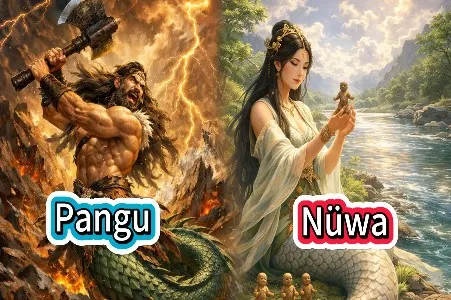
At last, Pangu found the form he liked best: a human face with a dragon's body—human on top, dragon on the bottom. Once he settled on that look, he suddenly realized something. He was trapped inside a place completely sealed off on all sides.
Not wanting to be stuck forever, he began trying to break out of the giant egg that surrounded him. He rammed into the shell with all his strength—but no matter how hard he tried, the egg wouldn't budge. It wouldn't crack at all.
So Pangu had to stop and think. He thought to himself, "Hmm… this isn't working. If something doesn't work, repeating it over and over probably won't magically make it work."
But what else could he do?
After a long time thinking, Pangu came up with an idea. Maybe he could use a tool. So he used his incredible shape-shifting powers and conjured up a massive axe. Gripping the axe tightly, he swung it with all his strength at the eggshell.
Crash!~~~
With one mighty strike, he finally split the giant egg open.
At that exact moment, dramatic changes began to happen. The light, warm, glowing elements floated upward and became the sky. The heavy, murky, cold, dark elements sank downward and became the earth.
Pangu could finally see the outside world—but before he had time to admire it, he noticed something was wrong. The sky and earth were starting to come back together!
Panicking, he instinctively stretched out his arms and held them apart, preventing them from merging again.
But just standing there holding them apart didn't seem like a long-term solution. So Pangu came up with another plan. Since he was good at transforming himself, he decided to grow taller. He figured if he could push the sky higher, the sky and earth might finally stay separated for good.
So he did exactly that. He kept growing taller... and taller... and taller.
What he didn't realize was how unbelievably heavy the sky was. No matter how hard he tried, he could only push it up about ten feet a day. At the same time, the earth grew thicker by ten feet each day.
And so it went on like that...for another 18,000 years. Pangu held up the sky and braced the earth with all his might, until one day he felt that the weight above him had finally lifted.
Carefully, he loosened his hands just a little.
The sky didn't fall.
He had done it. The sky and earth would never merge again.
Finally able to relax, Pangu lowered his arms. But after tens of thousands of years of nonstop labor—no breaks, no vacations—he was utterly exhausted. He decided to lie down and rest for a while.
As soon as he lay down, he fell into a deep sleep.
And no one expected that once he closed his eyes, he would never wake up again.
Ancient people believed that after Pangu died, his breath became the wind and clouds; his voice became thunder; his two eyes turned into the sun and the moon; his bones and teeth became metals, jade, and minerals; his blood became rivers, lakes, and oceans. His body itself became what later generations called the Pangu Continent.
With Pangu gone, the world fell silent once again.
No one knows how long it stayed that way. But one day, another life finally appeared. Her name was Nüwa.
The Creator of Life — Nüwa
Nüwa looked somewhat like Pangu. She had a human face and a serpent’s body—human on top, snake below.
At first, she wandered around the beautiful mountains and rivers of the Pangu Continent, and life was pretty pleasant. But after a while, she started to feel lonely.
She thought, "Hmm… maybe I should create some living beings to keep me company."
Once she made up her mind, she got to work.
On the first day of the lunar new year, she created a chicken. The next day, a dog. Then, one per day, she made pigs, sheep, cows, horses… and kept going like that for six straight days.
On the seventh day, she decided to take a break. She went down to a river to freshen up. And while she was there, she happened to see her reflection in the water.
She thought, “Why haven’t I tried making something that looks like me?”
So she picked up some yellow clay from the riverbank and started shaping little figures in her own image.
At first, the figures only had tails, like hers—but they couldn’t stand upright very well. “That won’t work,” she thought.
She considered giving them four legs like the animals she had made earlier—but that didn’t look like her anymore. So after some adjustments, she gave them two legs instead.
Then she leaned down and gently blew a breath of air onto the clay figures.
Instantly, they came to life.
They moved.
They laughed.
They played.
Nüwa was delighted. These little humans were way more interesting than the animals! So she kept making more and more of them.
But remember—she had already been working six straight days without rest. She thought, “If I keep hand-shaping them one by one, I’m going to collapse.”
So she had a clever idea. She picked up a vine from the riverbank, dipped it into muddy clay, and whipped it against the ground. Mud splattered everywhere in tiny droplets.
She blew gently over the droplets—
And just like that, each tiny speck of mud turned into a person.
Suddenly, the Pangu Continent was bustling with life.
With practice, Nüwa became faster and faster at creating living things. Legend says she could create seventy different kinds of creatures in a single day. All the living beings on earth were said to have been created by her.
But even though Nüwa could create life, she couldn't change one natural law: all living things grow old and eventually die.
So she thought, "If every time they die I have to remake them one by one...how long will that take?"
It was a tough problem. Even the great goddess Nüwa had to think about it for a very long time.
Finally, she came up with a solution: she would allow her creations to reproduce on their own.
She divided them into yin and yang—male and female. When a male and a female united, they could give birth to new life.
And just like that, the cycle of life began.
Because Nüwa created humans on the seventh day, the seventh day of the lunar new year is still known as "Human Day."
Maybe it's a coincidence—or maybe there's something mysterious behind it. In Chinese legend, humans were made from clay in the image of Nüwa, brought to life by her breath. In the Western Bible, humans are also said to be formed from dust in God's image, then given life by divine breath.
Isn't that an interesting similarity?
So that's the story of how Pangu opened the world and Nüwa created life.
Next time, we'll move forward into ancient times and begin with three legendary rulers who shaped early human civilization—the Three Sovereigns.
What fascinating stories await in their era?
You'll have to tune in next time to find out.