
Selecting the correct capacity mobile boat hoist is not a theoretical decision—it directly determines operational safety, vessel compatibility, turnaround efficiency, and long-term cost control in a marina environment. Underestimating capacity leads to structural overload risks, while overestimating results in unnecessary capital investment. The correct approach is a structured evaluation based on vessel weight reality, usage pattern, marina growth plans, and lifting conditions.
This article focuses strictly on how to determine the right capacity without ambiguity or overgeneralization.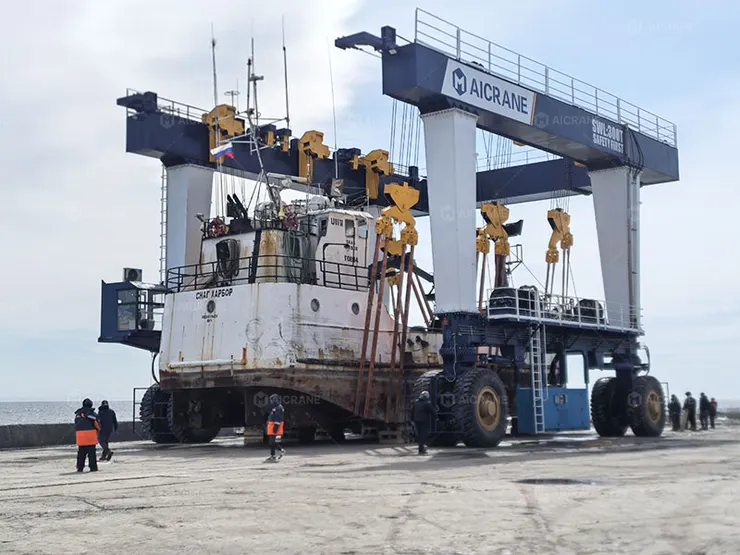
1. Start with real vessel weight, not brochure specifications
The first mistake in hoist selection is relying on “dry weight” alone. Boat weight on paper is never the actual lifting weight in operation.
A correct calculation includes:
- Dry hull weight
- Fuel load
- Water tanks
- Engines and onboard systems
- Equipment, gear, and supplies
Industry practice shows that operational weight can be significantly higher than catalog weight. For example, fuel and water alone can add several thousand pounds depending on vessel size.
For mobile boat hoists, this is critical because lifting systems are directly load-dependent and cannot compensate for miscalculation during operation.
Practical rule:
Use maximum loaded vessel condition, not “empty boat weight.”
2. Apply a safety margin that reflects real marina operation
A mobile boat hoist should never operate at its rated maximum continuously. In real marina conditions, loads fluctuate due to:
- uneven weight distribution
- retrofitted equipment on boats
- future vessel upgrades
- lifting angle variation
- sling positioning differences
Industry guidance commonly recommends selecting a hoist capacity with a 20%–25% buffer above maximum calculated vessel weight to ensure safe operation and future flexibility.
This buffer is not optional—it is what prevents overload stress on slings, structural frame, and hydraulic or winch systems.
Practical rule:
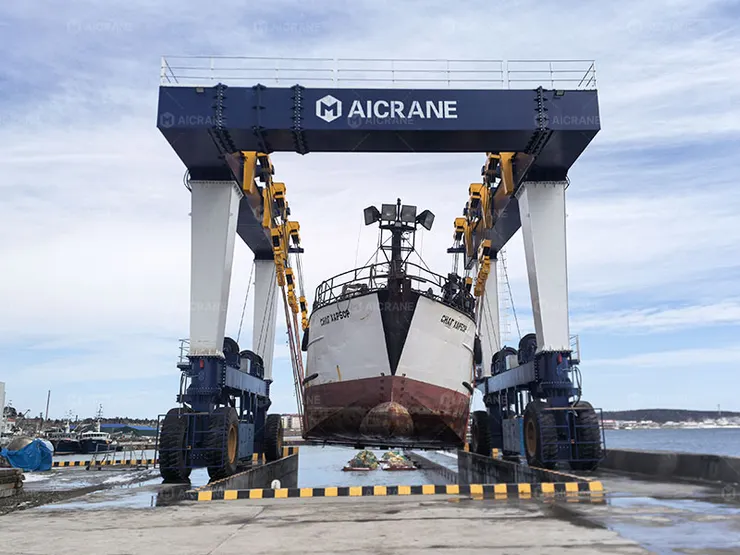
If your heaviest boat is 80 tons loaded → choose at least 100 tons class.
3. Match capacity to vessel mix, not a single boat
Marinas rarely handle one vessel type. A proper capacity decision must reflect the entire operational mix:
- sailboats (light but wide mast geometry)
- powerboats (higher concentrated weight)
- catamarans (wide beam load distribution)
- fishing or commercial vessels (high density weight)
Even if most boats are small, one heavy vessel defines the minimum safe capacity threshold.
Mobile boat hoists are commonly manufactured across a wide range, from tens to hundreds of tons specifically to accommodate this variability.
Key mistake to avoid:
Sizing based on average boats instead of peak-load boats.
4. Consider lifting geometry, not just tonnage
Capacity is not the only limiting factor. The geometry of lifting directly affects real usable capacity.
Important parameters include:
- beam width (maximum vessel width)
- sling spacing range
- hoist internal clearance
- lifting height above waterline
- hull shape compatibility
A hoist may be rated for a certain tonnage, but if sling positioning is incorrect or uneven, load stress increases significantly.
This is especially important for:
- catamarans (wide load distribution)
- deep-V hulls (concentrated keel load)
- custom yachts (non-standard balance points)
Practical rule:
Capacity must match both weight + geometry compatibility.
5. Understand duty cycle: frequency changes capacity requirements
Two marinas with identical vessels may still require different hoist capacities depending on operational intensity.
High-frequency operations create:
- heat accumulation in hydraulic systems
- faster wear on cables and slings
- increased fatigue cycles on structural frame
A hoist operating 20–30 lifts per day experiences far higher stress than one operating a few lifts per week.
In high-throughput marinas, selecting a higher capacity travel lift reduces:
- mechanical strain per cycle
- peak stress events
- long-term maintenance cost
Practical rule:
Higher frequency = higher safety margin in capacity selection.
6. Factor in future vessel growth (not just current demand)
One of the most costly mistakes in marina equipment planning is underestimating future vessel size trends.
Common growth patterns include:
- customers upgrading boats over time
- marina expansion into larger yacht segments
- shift from recreational to commercial vessels
- seasonal charter fleet changes
Industry experience shows that upgrading a hoist later is significantly more expensive than selecting higher capacity initially.
Even small increases in capacity (e.g., from 80T to 100T class) often have relatively minor cost differences compared to full system replacement.
Practical rule:
Always size for “next 5–10 years,” not current demand.
7. Ground conditions and structural load distribution matter
Mobile boat hoists transfer full vessel weight into ground pressure through tires or travel wheels. Therefore, capacity selection must align with:
- pavement strength
- soil compaction
- marina haul-out area design
- turning load stress
Higher capacity hoists generate higher wheel loads, which may require reinforced operational areas.
Ignoring this leads to:
- surface cracking
- uneven travel path
- long-term structural damage to marina infrastructure
Practical rule:
Capacity selection must include civil engineering compatibility.
8. Operational control systems become more important at higher capacity
As capacity increases, control precision becomes more critical, not less.
Higher-capacity hoists require:
- synchronized hoist control
- independent sling adjustment systems
- overload monitoring systems
- anti-sway control
- real-time weight feedback
Modern mobile boat hoists often include electronic weighing systems and overload protection to ensure safe lifting across variable vessel types.
Without these systems, higher capacity becomes unsafe rather than useful.
9. Cost logic: avoid both under-sizing and over-sizing traps
Capacity selection is ultimately an economic decision.
- Under-sizing → operational risk, limited service capability, lost contracts
- Over-sizing → unnecessary capital expenditure and higher maintenance load
However, in real marina economics, under-sizing is usually more expensive long-term due to operational limitations and missed service opportunities.
The optimal approach is:
- match peak vessel weight
- add safety margin
- include future growth
- avoid unnecessary oversized industrial models
Conclusion
Choosing the right capacity mobile boat hoist is a structured engineering decision, not a simple tonnage selection.
A correct selection process must integrate:
- true maximum vessel weight (not dry weight)
- safety margin of 20–25%
- vessel type diversity
- operational frequency
- future marina growth
- ground load conditions
- control system capability
When these factors are aligned, the result is not just safe lifting—it is predictable operations, reduced downtime, and long-term cost stability for the marina.


