(for International Students who plan to work in Taiwan)
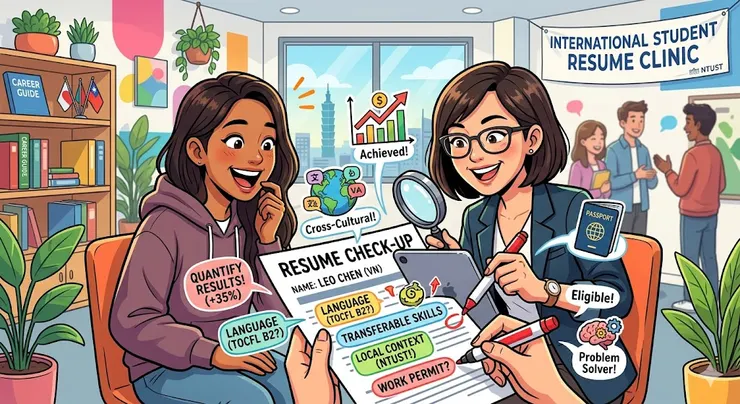
For international students who plan to work in Taiwan, the resume focus goes beyond skills and experience. Employers are often evaluating not just what you can do, but also how easily you can integrate, communicate, and stay long-term.
This adds an extra layer to resume strategy: reducing uncertainty while highlighting unique value.
1. Turn Language Skills into Work-Ready Evidence
For local students, listing test scores (TOEIC, IELTS) is often enough. For international students, this is not sufficient.
Employers may want to know:
- Can you join meetings?
- Can you write emails?
- Can you collaborate with local teams?
Weak example:
- Chinese: Intermediate
Strong example:
- Mandarin: B2 – able to conduct meetings and write business emails
- Completed academic reports in Chinese
👉 Your resume should answer: “Can I trust this person to function in a real work setting?”
2. Reduce Hiring Friction
(Visa & Work Eligibility)
Unlike local candidates, international students must address legal work status clearly.
Include a simple, reassuring statement such as:
- Eligible for work in Taiwan (no sponsorship required)
- ARC valid until [date]
👉 This small detail can significantly increase your chances of getting an interview.
3. Show Strong Connections to Taiwan
Employers may worry that international candidates are only temporary.
To reduce this concern, highlight:
- Internships in Taiwan
- Local academic or industry projects
- Collaboration with Taiwanese teams
Examples:
- Collaborated with Taiwanese teams on marketing campaigns
- Conducted market research on Taiwan consumers
👉 The goal is to demonstrate commitment and familiarity with the local environment.
4. Quantify Achievements and Emphasize Business Impact
All candidates should quantify results—but for international students, this is even more critical.
Why? Because employers may ask:
“Why should I hire this candidate over a local one?”
Weak example:
- Participated in a marketing project
Strong example:
- Increased engagement by 35% in a cross-border campaign targeting Southeast Asian markets
👉 Your resume should clearly show your competitive advantage.
5. Make Cross-Cultural Skills Concrete
Many candidates mention “cross-cultural communication,” but few prove it.
Weak example:
- Good cross-cultural communication skills
Strong example:
- Coordinated between Taiwanese and Vietnamese teams to align project timelines
- Resolved communication gaps in a bilingual working environment
👉 Focus on real situations, actions, and outcomes.
6. Be Clear About Your Career Direction
A vague career goal creates more uncertainty—especially for international candidates.
Weak example:
- Open to various opportunities
Strong example:
- Seeking roles in supply chain management or Southeast Asia business development
👉 Clarity builds trust and makes hiring decisions easier.
Final Thought
A strong resume for local students proves:
“I can do the job.”
A strong resume for international students must also prove:
“I can do the job, adapt quickly, and bring extra value without adding risk.”
When done right, your international background is not a disadvantage—it becomes your strongest differentiator.