字紙之敬.屏東 佳冬 / 27x12cm.水彩
A Reverence for the Written Word.Jiadong Village, Jiadong Township, Pingtung County / 27x12cm.watercolor
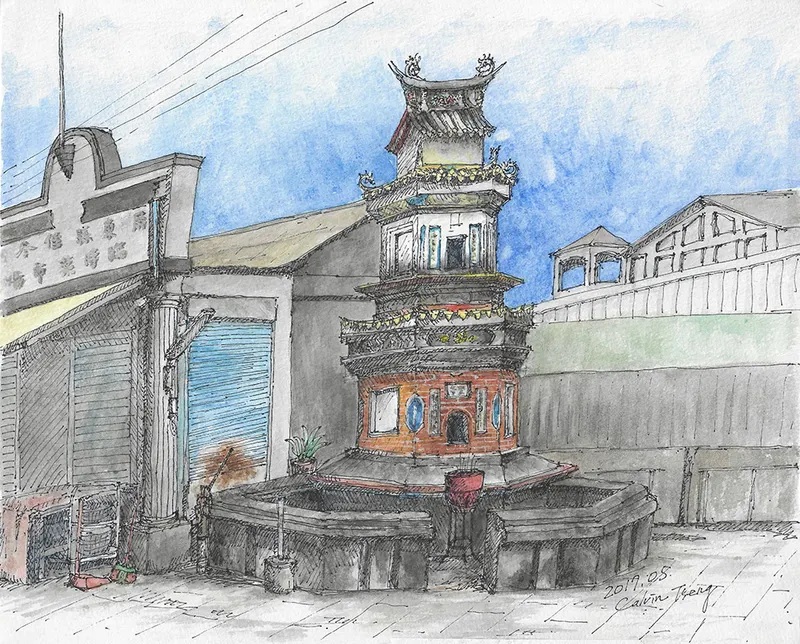
敬字亭,又名聖蹟亭,座落於佳冬蕭家古厝步月樓外,為國家三級古蹟,建於清道光三十年。其建築為寶塔式,首層用以焚化字紙,上層供奉倉頡先師、文昌帝君與文魁星君。
在客家聚落中,敬字亭承載著「敬惜字紙」的信仰精神。文字得來不易,凡紙片書字,皆不忍隨意棄置,而以焚化表達敬意。此風源於「晴耕雨讀、耕讀傳家」的文化傳統,也寄託對倉頡、孔子、韓愈與蔡倫等先賢的敬仰。
敬字亭不僅是一座建築,更是一種對知識與文化的珍重與傳承。
Respect Words Pavilions, also known as the Sacred Relics Pavilion, stands outside the Buyue Tower of the Xiao Family Residence in Jiadong. Built in 1850 during the Qing Dynasty (Daoguang era), it is designated as a national third-grade historic site. Designed in a pagoda-like form, its lower level was used for burning written paper, while the upper level enshrines Cangjie, the legendary creator of Chinese characters, along with Wenchang Dijun and the God of Literature.
In Hakka communities, Respect Words Pavilions embodies the tradition of revering written words. Paper bearing text was never casually discarded; instead, it was respectfully burned as an act of cultural devotion. This practice reflects the enduring values of “farming and studying side by side,” and honors cultural figures such as Cangjie, Confucius, Han Yu, and Cai Lun.
More than a structure, Respect Words Pavilions represents a deep respect for knowledge and cultural continuity.


字紙之敬.屏東 佳冬 / 27x12cm.水彩
A Reverence for the Written Word.Jiadong Village, Jiadong Township, Pingtung County / 27x12cm.watercolor
敬字亭,又名聖蹟亭,座落於佳冬蕭家古厝步月樓外,為國家三級古蹟,建於清道光三十年。其建築為寶塔式,首層用以焚化字紙,上層供奉倉頡先師、文昌帝君與文魁星君。
在客家聚落中,敬字亭承載著「敬惜字紙」的信仰精神。文字得來不易,凡紙片書字,皆不忍隨意棄置,而以焚化表達敬意。此風源於「晴耕雨讀、耕讀傳家」的文化傳統,也寄託對倉頡、孔子、韓愈與蔡倫等先賢的敬仰。
敬字亭不僅是一座建築,更是一種對知識與文化的珍重與傳承。
Respect Words Pavilions, also known as the Sacred Relics Pavilion, stands outside the Buyue Tower of the Xiao Family Residence in Jiadong. Built in 1850 during the Qing Dynasty (Daoguang era), it is designated as a national third-grade historic site. Designed in a pagoda-like form, its lower level was used for burning written paper, while the upper level enshrines Cangjie, the legendary creator of Chinese characters, along with Wenchang Dijun and the God of Literature.
In Hakka communities, Respect Words Pavilions embodies the tradition of revering written words. Paper bearing text was never casually discarded; instead, it was respectfully burned as an act of cultural devotion. This practice reflects the enduring values of “farming and studying side by side,” and honors cultural figures such as Cangjie, Confucius, Han Yu, and Cai Lun.
More than a structure, Respect Words Pavilions represents a deep respect for knowledge and cultural continuity.