Last time, we talked about how Pangu opened the world and Nüwa created life.
This time, we're diving into three major figures from ancient times: Suiren Shi, Fuxi, and Shennong — the legendary rulers later honored together as the "Three Sovereigns, also called San huang."But before we get into their stories, I want to introduce one more figure: Youchao Shi. Just hearing his Chinese name, you can probably guess what he's known for — teaching people how to build houses. So why did humans need someone to teach them that? Well...that's where our story begins.
Youchao Shi
Way back in ancient times, humans originally lived in caves. But as the population grew, a big problem popped up — caves don't magically multiply just because people do. So what happens when there aren't enough caves to go around?
The people without shelter had no choice but to move out into the open.
But humans aren't wild animals. We don't have sharp claws or thick fur to protect us from the cold. Living fully exposed in the wilderness was extremely dangerous. And it was in this context that Youchao Shi emerged.
After a long time observing, thinking, and experimenting, he figured out how to build simple shelters using branches and wood. Then he taught everyone else how to do it.
Later generations called this method "building nests from wood." And notice — it wasn't called building a house. It was called building a "nest. "That's because those early shelters were pretty rough — more like bird nests than actual houses. Still, they solved the basic problem of having a place to live.
Once humans moved from cave-dwelling to nest-dwelling, civilization reached another major turning point: the invention and use of fire.
Suiren Shi
Why was fire such a game changer?
Because as far as we know, humans are the only creatures that know how to use fire. And fire is connected to everything — pottery, metal tools, cooking. Without fire, modern civilization wouldn't exist. It's one of the biggest differences between humans and animals.
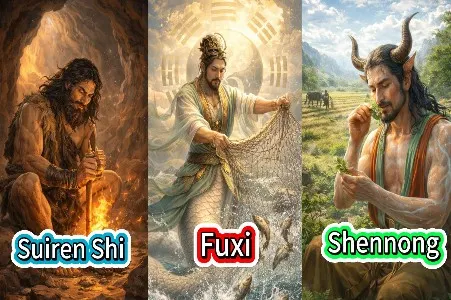
Legend says that fire-making was invented by Suiren Shi.
One day, when he was starving, he smelled something coming from animals that had been burned in a forest fire. The smell was incredible. Now normally, even animals won't eat creatures that weren't hunted directly — they might have died from poison or disease. But Suiren Shi was desperate. So he picked up a piece of the cooked meat and ate it.
And guess what? It tasted better than raw meat — and he didn't get sick.
After that, he couldn't stop thinking about it. But here's the problem: how do you make fire? He couldn't just wait around for another forest fire. And wildfires aren't exactly controllable.
So he started wondering: how can I create fire myself?
Instead of just daydreaming about it, he decided to go out and search for answers. During his journey, he arrived at a place surrounded by towering trees so thick that barely any sunlight got through. As he walked nervously through the dark forest, he suddenly heard a knocking sound.
Knock. Knock. Knock.
He followed the sound and saw tiny sparks flying. It was a woodpecker pecking at a tree.
And in that moment, something clicked. If pecking at wood creates sparks... what if hitting or rubbing wood together could create fire?
So he went home and began experimenting. Fail. Try again. Fail again. Try again.
Eventually, he succeeded. He invented what we now know as "drilling wood to make fire."
Once humans could control fire, everything changed. They could cook food, kill harmful bacteria, reduce disease, and live longer. As the population grew, people began dividing labor — some hunted, some gathered fruit, some protected the group.
Society slowly began to form.
Humans even learned to use animal bones as needles to sew fur into clothing. But life was still pretty primitive back then, which is why later generations called this period the "Paleolithic Age."
And if there's a Paleolithic Age, that means there must also be a "Neolithic Age." Which brings us to two important figures from that era: Fuxi and Shennong.
Fuxi
According to legend, Fuxi was born after his mother stepped into the footprint of the Thunder God and became miraculously pregnant — for twelve years.
When he was born, he had the upper body of a human and the lower body of a snake — just like Nüwa.
Fuxi was incredibly intelligent. He invented pottery, created a marriage system, and replaced knot-tying record keeping with written symbols. His most famous creation? The "Eight Trigrams( Bar gua )."
One day, he saw a strange creature — part dragon, part horse — rise from a river carrying a mysterious diagram later called the "River Map ( He Tu )." After long study, and inspired by patterns he saw on a turtle's shell, he realized that everything in the universe is made up of two fundamental forces: Yin and Yang.
By combining yin and yang in groups of three, he formed eight symbolic patterns — the Eight Trigrams.
Later, King Wen of Zhou expanded them into sixty-four hexagrams, forming the foundation of the "I Ching", one of the most important philosophical texts in Chinese culture.
But Fuxi didn't stop there.
After Fuxi improved the hunting tools, people could not only catch animals on land but also capture creatures in the water.But this upgrade didn't sit well with the Dragon King—he was furious. You see, many of the fish in the rivers were actually the Dragon King's own descendants.
So the angry Dragon King came to confront Fuxi and said,"You can't keep catching fish like this anymore."Hearing that, Fuxi fired back,"If we're not allowed to catch fish, then what are we supposed to eat?" And just like that, the two of them argued for a long time, but neither side could reach an agreement.
At that moment, the Dragon King's turtle prime minister stepped forward and offered a suggestion. He said to Fuxi, "Hunting wild animals and catching fish are not the same. When an animal is injured, humans will keep chasing it until they finally catch it. So most of the time, it eventually becomes your food. But when a fish is injured, it usually just gets carried downstream by the current and dies somewhere else. You humans can't retrieve it or eat it, so it ends up being wasted. Isn't that a terrible waste? So if you can find a way to catch fish without stabbing them with sharp spears, then no matter how many fish there are in this river, you're free to catch them."
When the Dragon King heard this, he nodded."Hmmm... Turtle Prime Minister, you make a good point." Then he turned to Fuxi and said, "That's right. All living things were created for everyone to use. But wasting life or killing recklessly isn't right, is it? I think the turtle's suggestion is reasonable. So here's the deal. You can accept our proposal. But if you refuse and insist on catching fish with those sharp spears... then don't blame me if I flood your village with a great storm."
Hearing this, Fuxi realized that the Dragon King and the turtle prime minister did have a point. Besides, if he clashed with the Dragon King directly, there would surely be casualties.
So after thinking it over, he replied, "Alright. I accept your challenge."
The Dragon King was delighted. Inside, he thought to himself, "Hmph! I don't believe that without spears, you can catch more than a few fish with your bare hands."
Although Fuxi accepted the challenge, things turned out exactly as the Dragon King expected. Without using spears, catching fish in the river became just as difficult as it had been in the old days. As the amount of fish people could catch dropped sharply, hunger began to spread again among the people. This made Fuxi extremely anxious. He desperately tried to think of a solution.
One day, while lying under a tree thinking about the problem, he suddenly noticed a spider weaving its web to catch insects. The moment he saw it, Fuxi suddenly shouted,"Ah! Why didn't I think of this before? I can learn from the spider and weave a net to catch fish!"
So he immediately began working on making a fishing net. Of course, a fishing net couldn't be exactly the same as a spider's web. So he went through many rounds of trying, adjusting, and improving it. Try again. Fix it. Improve it. Then try again. Finally, he succeeded.
When he took the finished net to the river and cast it into the water, something incredible happened. He caught even more fish than before—and none of them were injured. Just like that, Fuxi successfully passed the Dragon King's challenge. And the Dragon King... well, he had no choice but to swallow his frustration.
After solving the fishing problem, Fuxi realized there was another challenge: in winter, the rivers would freeze over, so even with fishing nets, people couldn't catch anything. On top of that, land animals would become scarce with the cold season, and soon, people might be starving again. So he started trying to domesticate some of the less aggressive animals to make sure there would always be food.
Of course, creating something out of nothing is always hard. What seems simple to us now was a huge breakthrough back then—it basically moved human civilization from simple hunting and gathering into the age of animal husbandry. Because of Fuxi's incredible inventions and contributions, later generations honored him by taking the "Hua" from his homeland, Huaxu, to name our people—and that's how Chinese civilization , or "Zhonghua culture," came into being.
Shennong
Leadership eventually passed to Shennong.
Legend says he had the head of an ox and a transparent body. And yes — transparent. So when he ate plants, he could literally see how they affected his internal organs.
He taught people how to farm the five grains, invented early farming tools, and brought humanity fully into the agricultural age.
But what he's most famous for is personally tasting hundreds of plants to test their medicinal properties. He carefully recorded their effects, which later became known as the "Shennong Bencao Jing."
Because of his mastery of fire and agriculture, he was also called the "Flame Emperor ( Yan Emperor )."
As agriculture advanced and populations grew, so did conflicts between tribes. Eventually, humanity couldn't avoid its first great ancient war — the "Battle of Banquan."
With war came alliances. With alliances came new forms of leadership.
So where would human civilization go next?
And how would this story unfold?
You'll have to tune in next time to find out.