As global trade continues to grow, the demand for faster, more flexible, and cost-effective container handling solutions has never been greater. Container gantry cranes, whether rail-mounted (RMG) or rubber-tyred (RTG), play a critical role in port and terminal operations. Among the most transformative innovations in this space is the modular design approach, which allows for standardized, adaptable, and scalable crane systems. This article explores the concept of modular design in container gantry cranes, its advantages, and its practical applications in modern terminal logistics.
Understanding Modular Design
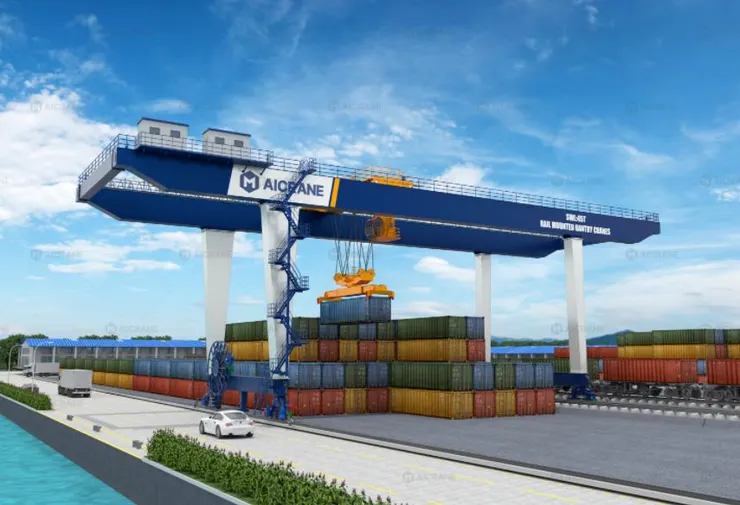
Modular design is a systems engineering approach where a product is divided into independent, interchangeable modules that can be easily assembled, upgraded, or replaced. In the context of container gantry cranes, this means that major components—such as the main girder, trolley system, hoisting mechanism, power systems, and control cabins—are designed as standardized modules.Each of these modules is engineered to integrate seamlessly into a larger crane system. Instead of a custom-built machine for each project, manufacturers can deliver cranes using a library of proven modules tailored to the customer’s operational requirements.
Key Modular Components in Container Gantry Cranes
- Main Girder Module
The main girder supports the trolley and hoisting mechanisms. Modular designs allow varying lengths and structural capacities, enabling flexible span configurations based on container yard layout. - Trolley and Hoisting Mechanism
This module includes hoisting motors, wire rope systems, and the trolley structure itself. Modules can be optimized for single-lift or twin-lift container handling. - Leg and Portal Frame
Modular portal frames and support legs allow for easy adjustments in height and track gauge, making it easier to adapt cranes to different terminal designs. - Drive and Steering Modules
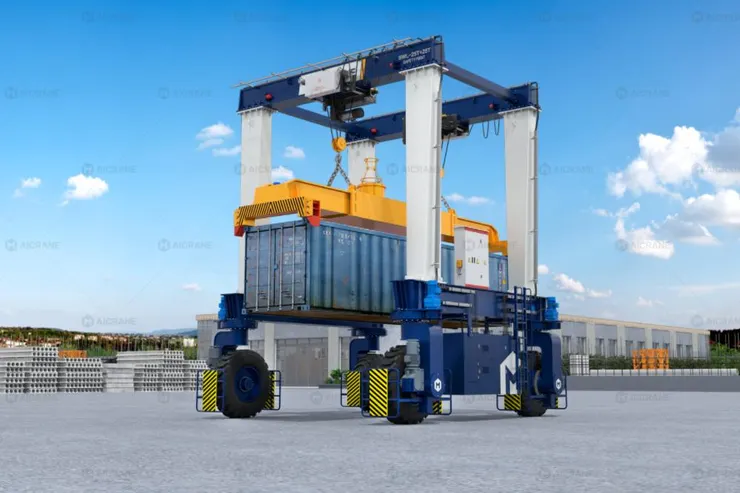
In RTG cranes, the steering and drive systems are designed as modular wheel assemblies, with steerable bogies that can support different movement modes (straight, 90°, carousel, diagonal). - Power and Cable Reel Systems
Power modules include onboard diesel gensets, electric cable reels, or hybrid energy storage systems, depending on the crane’s power source. - Operator Cabin and Control Systems
Cabins and controls are standardized for rapid installation and can include manual, remote, or semi-automated control systems.
Advantages of Modular Design for Container Gantry Cranes
1. Reduced Lead Times
One of the most significant benefits of modular design is the reduction in production and delivery timelines. Since modules are pre-designed and manufactured in advance, they can be stocked and assembled much faster than entirely custom-built systems.
2. Cost Efficiency
Modular cranes require less design effort for each project, reducing engineering hours and enabling economies of scale in manufacturing. Customers benefit from a lower total cost of ownership and faster ROI.
3. Scalability and Flexibility
Terminals can start with a basic crane configuration and later upgrade by adding or replacing specific modules. For example, a crane can be upgraded from diesel to hybrid-electric by swapping out the power module.
4. Ease of Maintenance
Modular systems make maintenance and replacement of worn or outdated parts easier. Maintenance teams can remove and replace modules without needing to overhaul the entire crane.
5. Global Standardization
Using a standardized modular platform allows global operators to streamline training, operations, and maintenance across different terminals. Spare parts are more widely available and easier to source.
Design Considerations in Modular Container Crane Systems
Designing modular gantry cranes is not without challenges. Engineers must ensure that each module meets performance standards and interfaces properly with other modules. Here are key design factors:
- Interface Compatibility: All modules must adhere to standardized connection interfaces to allow quick and accurate assembly.
- Structural Integrity: While modular, each component must perform under heavy dynamic loads, including wind, hoisting shocks, and trolley travel.
- Load Distribution: Proper load balance across modules is critical, especially in tall RTG cranes that operate on uneven outdoor surfaces.
- Safety Integration: Safety systems must function seamlessly across all modules, including emergency stops, sensors, and interlocks.
- Power Integration: Whether using cable reels, busbar systems, or gensets, power modules must integrate smoothly with drive and control systems.
Real-World Applications of Modular Container Cranes
Many top crane manufacturers and port operators are leveraging modular designs for container gantry cranes. For example:
- Rapid Deployment in Emerging Markets
Ports in developing regions often require fast installation of cranes to meet growing trade volumes. Modular cranes allow for off-site manufacturing, containerized transport, and rapid on-site assembly. - Fleet Standardization in Large Terminals
Port operators managing multiple terminals can use modular cranes to standardize operational procedures and maintenance schedules, simplifying training and reducing downtime. - Upgrading Existing Infrastructure
Instead of replacing entire cranes, operators can upgrade trolley modules, hoisting mechanisms, or power systems independently, extending the service life of the crane. - Adaptation to Green Port Initiatives
As more ports pursue electrification and emission reduction goals, modular cranes allow for power system swaps and hybrid retrofits without a complete redesign.
Case Study: Modular RTG Cranes for Inland Container Depot
An inland container depot in Central Asia recently adopted modular RTG rubber tyred gantry cranes to expand their yard operations. The cranes were shipped in pre-assembled modules, minimizing on-site installation time. Initially powered by diesel engines, the RTGs were later upgraded with lithium-ion battery modules and energy recovery systems, showcasing the flexibility of modular design in real-world conditions.
The Future of Modular Crane Design
As smart technologies, automation, and sustainable practices continue to shape the future of container handling, modular design will be an enabler for innovation. Future developments may include:
- Plug-and-play automation modules for semi-autonomous operation.
- AI-enabled maintenance systems that monitor each module individually.
- Digital twins for modular crane configurations to simulate performance and plan upgrades.
- Custom 3D-printed parts for modular crane components in remote locations.
Conclusion
The modular design approach represents a powerful shift in how container gantry cranes are engineered, built, and maintained. By focusing on flexibility, standardization, and scalability, this approach enables port operators to stay competitive in an increasingly demanding logistics environment. Whether for large international ports or inland container depots, modular container gantry cranes offer the agility needed to meet today’s operational needs and tomorrow’s challenges.
If you're planning to invest in or upgrade your container handling equipment, consider modular crane solutions that offer long-term value, adaptability, and performance.