Last time, we finished talking about the Huangdi. This time, we're continuing with the second ruler among the Five Emperors — Zhuanxu.
After the Huangdi ascended to immortality, he passed his position on to his son Shaohao. Later, Shaohao handed the throne to his own son, Zhuanxu.Zhuanxu started assisting Shaohao when he was only fifteen, and by the time he was twenty, he had already become the ruler. Because he was so young when he took power, a figure named Gonggong thought this was the perfect opportunity to challenge him. Gonggong—whose name was Kanghui—was the legendary god of water. In the autumn and winter season, he launched an attack on Zhuanxu, kicking off a devastating war said to be more catastrophic than a nuclear-level disaster.
From the very beginning, Zhuanxu knew he couldn't defeat Gonggong by himself. So the moment he heard that Gonggong was coming, he immediately sent someone up to the heavenly court to ask the fire god Zhurong for help.
As soon as Zhurong heard Zhuanxu's plea, he mounted two dragons and rushed out to confront Gonggong. When Gonggong saw Zhurong arriving—and on the opposing side—he was furious. For one thing, both of them originally came from the tribe of the ancient ruler Yan Emperor. If Zhurong didn't want to help him, fine—but instead he showed up to support Zhuanxu, a descendant of the Huangdi's tribe. And secondly, Gonggong had always believed that water was far more important to humans than fire. Yet people at the time worshiped the fire god far more than the water god. So honestly, he'd been annoyed with Zhurong for a long time. So when Gonggong saw him, he didn't waste a second—he charged straight at Zhurong and the two started fighting.
Gonggong thought to himself: Why would Zhuanxu ask you for help? Doesn't he know water can put out fire? If he called you here, isn't he basically sending you to your death?
But was that really the case?
Actually, timing matters a lot in these things. At that moment it was late autumn heading into winter. Rivers were running low, and there was even a drought. Under those conditions, the situation actually favored the fire god Zhurong.
Taking advantage of the wind, Zhurong unleashed a massive blaze and quickly defeated Gonggong. Gonggong never expected to lose. In a rage, he fled west to "Mount Buzhou". Mount Buzhou was originally one of the great pillars supporting heaven and earth, and it also served as a gateway between the two realms. Gonggong went there hoping to ask the other gods for help.
But to his shock, no one paid any attention to him. Enraged, he thought: "Fine! If you won't open the gate for me, I'll smash it open. Worst case? We all go down together!" Then he started ramming Mount Buzhou with his head over and over again. He was so furious that he didn't even feel the pain. That one reckless act killed him. But worse than that—he actually broke the pillar of heaven.
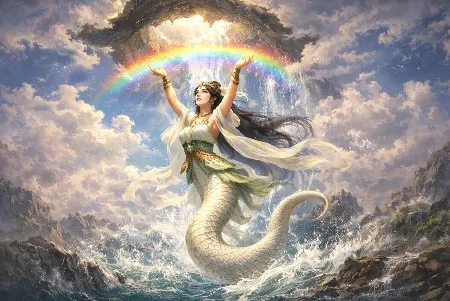
Once Mount Buzhou collapsed, it could no longer support the sky. The heavens tilted, and a massive hole tore open in the sky. Water from the heavens poured through that hole down to the human world, causing a catastrophic flood. Just as the world was about to be completely submerged, the great goddess Nüwa saw what was happening. She immediately traveled across the world collecting five-colored crystals: green, red, yellow, white, and black. In total, she gathered 36,501 stones. Then she fused them together—every hundred stones into one—creating 365 large crystals.
Using these 365 stones, she patched up the giant hole in the sky to stop the heavenly waters from leaking down again. Even after using all 365 stones, the sky was almost repaired. But there was still a small hole left—about one quarter the size of a fused crystal. The last crystal she had wasn't large enough to fill that gap.
At first, Nüwa planned to go collect more stones to finish the job. But then a thought suddenly crossed her mind. Maybe... she should leave the hole there. If the world's climate stayed perfectly stable forever, people might forget what happened today. But if things were occasionally unpredictable, humanity would always remember the disaster that almost destroyed them. So in the end, she decided not to finish the repair. Instead, she tossed the final crystal back down to the human world.
And that's how the famous legend of "Nüwa repairing the sky" began.
As for where that crystal ended up—well, different stories say different things. Some people believe it later became the incarnation of Jia Baoyu in the novel Dream of the Red Chamber. Others say it became the stone from which Sun Wukong was born in the novel Journey to the West.
After repairing the sky, Nüwa went to the East Sea and asked a giant divine turtle for help. She cut off the turtle's four legs and used them as pillars to support the heavens. Then she gave the turtle one of her garments to wrap around its wounds. Over time, the wounds healed, and the places where its legs once were eventually evolved into flippers. And that, according to the legend, is why sea turtles have flippers instead of legs.
Because Nüwa repaired the sky using five-colored stones, colorful clouds sometimes appear in the sky even today. And the 365 stones—plus that missing quarter—just happen to match the length of a year: 365 and a quarter days.
After thanking Nüwa for saving humanity from this world-destroying flood, Zhuanxu started thinking: What if someday another god does something reckless again? Wouldn't humanity face another disaster? So he sent two powerful figures—one named Chong and the other Li—to Kunlun Mountain.
He ordered Chong to push the sky upward, and Li to press the earth downward. Little by little, heaven and earth grew farther apart. From that moment on, humans could no longer communicate with the heavens. This event became known as Zhuanxu's famous reform: "separating heaven and earth."
After that, the only person who could communicate with the gods was the emperor himself. In other words, Zhuanxu had concentrated both divine authority and royal power into his own hands.
In his later years, Zhuanxu passed the throne to his nephew, Emperor Ku. Just like Zhuanxu, Emperor Ku began assisting the ruler when he was fifteen—but he didn't become emperor until he was thirty.
So during Emperor Ku's era, did another world-destroying war break out?
No.
If disasters like that happened every day, humanity would've gone extinct a long time ago.
That said, some pretty interesting stories did happen during Emperor Ku's reign.
How would this story unfold?
You'll have to tune in next time to find out.