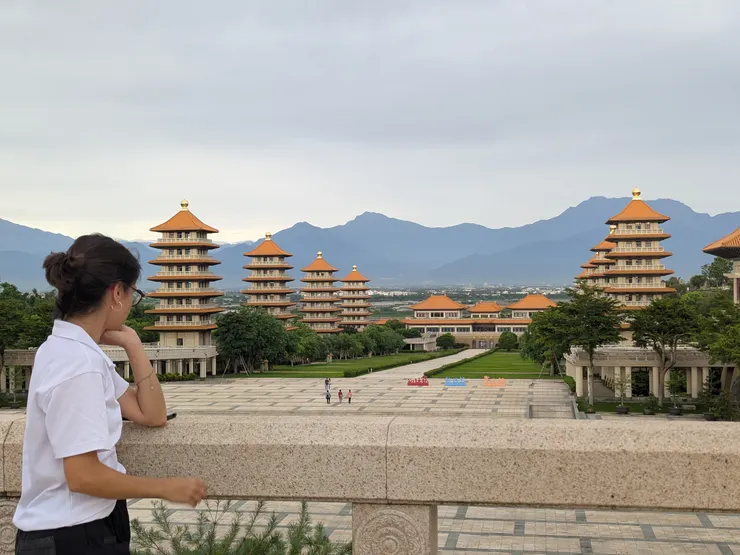
Estelle taking a view of the Museum from the Main Hall
Text & photos圖文 | Estelle Dubois
建築與自然星雲大師花了許多時間,尋找一塊真正適合興建佛陀紀念館的土地,最後他選擇了高雄大樹佛光山寺旁的這片山林。佛陀紀念館坐落在翠綠山景之中,園區內保留了豐富的自然,無論是樹木、公園或步道,都讓人感受到一種建築與自然共生的和諧。
這裡的空間規劃也展現出一種「靜」與「動」之間的平衡。例如,一般寺院內的空間多半平靜,而佛陀紀念館則更開放、活潑;即便如此,館內依然隨處可以找到靜心的地方。這種空間讓人無論身處哪個角落,都能找到安靜的角落。
佛陀紀念館的邊界
我發現,在華人建築文化中,一個常見的做法是 — 不讓建築的核心空間一開始就完全呈現在外人眼前。佛館的禮敬大廳便如一道門檻,將外在的日常與內在的心靈空間自然地劃分開來。只有穿越這個前廳,遊客才會步入那條壯闊的成佛大道 — 兩旁的八座寶塔、本館和一座巨大的坐佛。
但這種空間的邊,更像是「轉換」而不是「隔離」。園區內有許多入口與通道,每當走過其中一扇門,你會有種進入全新世界的感覺。
在某些邊界,牆也變成了長廊,不但引導人們的路線,又提供遮蔽。遊客一邊能望見館內的風景,另一邊則是牆上的佛法語句。這樣的設計,也體現了台灣建築在地氣候下對陽光與雨水的周到回應。
更大的視角
整體空間的規劃,是來自星雲大師的想像。園區以一條對稱的中軸線「成佛大道」為核心。從中央的禮敬大廳望向盡頭的本館,四座寶塔分列兩側,形成莊嚴而平衡的空間。
園區的地形也被巧妙地運用 — 從入口緩緩上升到本館,使得整個空間更有層次,也放大了視覺上的莊嚴感。當人們順著中軸線從低處往上走,不僅是空間的移動,更像是一種心靈上的提升。
在這裡,建築不只是形體,而是情感的媒介。每一個轉角、每一道門、每一條軸線,都是為了讓人重新感受自己與空間、與信仰、與世界的連結。
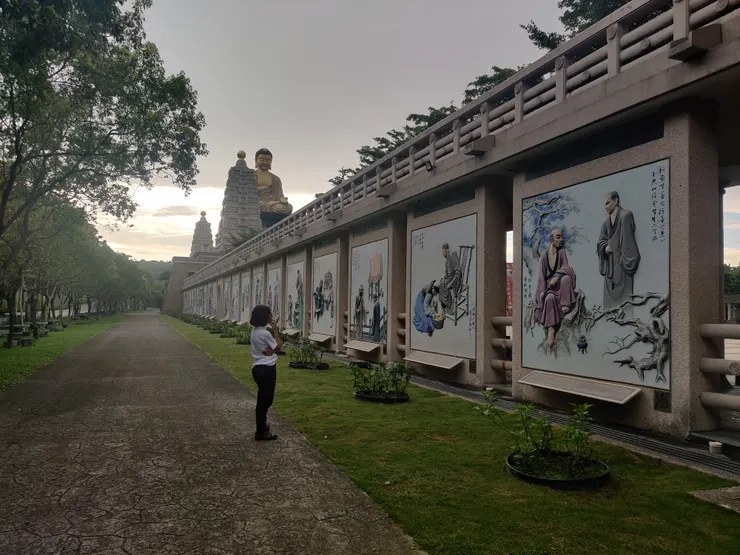
Estelle looking at the large-sized murals on the external walls flanking the Bodhi Wisdom Concourse
The Context: Building in Nature
Venerable Master Hsing Yun took time to find the perfect location to build the museum, eventually choosing the land next to the monastery in Dashu. The museum is set amidst lush greenery. Nature is still very present within the museum grounds — with its parks and trees — creating a harmonious balance between architecture and the natural environment.
One can also sense a complementarity between calm and lively spaces: between the monastery and the museum (even though some parts of the monastery are open to visitors), and within the museum itself, where quiet corners are always available for reflection.
Borders of the Museum?
As I understand it, in Chinese architecture, it is common to conceal the core space of a building from immediate view. The Front Hall acts as a threshold, almost forming a boundary between daily life and the inner spiritual world of the museum. Visitors must pass through this space before discovering the impressive perspective of the eight pagodas, the Main Hall designed like a giant stupa, and the Great Buddha.
However, I feel that these “borders” are more like transitions than separations. There are many “gateways” throughout the grounds, and each time you pass through one, it feels as though you’ve entered a new world.
In some areas, these borders become galleries that guide and protect visitors. On one side, you can look out onto the inner landscape; on the other, you encounter Buddha’s teachings inscribed on the walls. These passageways also provide shelter from the sun and rain — a common architectural response in Taiwan’s climate.
The Great Perspective
The museum’s layout was envisioned by Venerable Master Hsing Yun. The entire master plan is centered on a symmetrical axis known as the “Great Path to Buddhahood.” The Front Hall serves as the central entrance, directly aligned with the Main Hall — a monumental stupa — at the far end. Flanking the path are four pagodas on each side.
The sloping terrain of the museum enhances this arrangement. The path gently ascends from the Front Hall to the Main Hall, amplifying the visual impact and sense of grandeur. As visitors walk along this central path — from the lower entrance to the upper sanctum — they are invited to experience a spiritual ascent as well.
Here, architecture becomes a medium for evoking emotion. Every turn, every doorway, and every axis is designed to deepen one’s connection — with the space, with faith, and with the world.
#佛光山 #佛陀紀念館 #喬達摩 #GAUTAMA
更多內容請見 190期《喬達摩》專刊 線上電子書