𝟐𝟎𝟐𝟔 𝐍𝐓𝐔 𝐅𝐢𝐥𝐦 𝐅𝐞𝐬𝐭𝐢𝐯𝐚𝐥
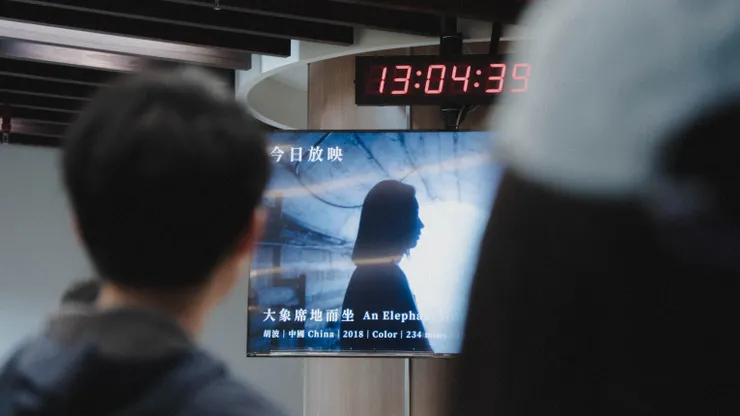
𝐀𝐧 𝐄𝐥𝐞𝐩𝐡𝐚𝐧𝐭 𝐒𝐢𝐭𝐭𝐢𝐧𝐠 𝐒𝐭𝐢𝐥𝐥|𝟘𝟛/𝟙𝟝 𝕊𝕦𝕟. 𝐏𝐨𝐬𝐭-𝐒𝐜𝐫𝐞𝐞𝐧𝐢𝐧𝐠 𝐓𝐚𝐥𝐤
🎬 An Elephant Sitting Still
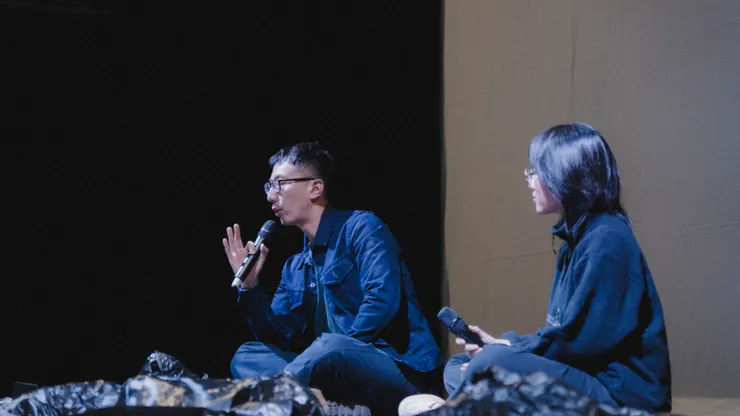
⭐️ Speaker: Professor Chang-Min Yu, Department of Foreign Languages and Literatures, National Taiwan University
🔹 This article is not a verbatim transcript and does not represent the speaker’s personal stance.
────⊱⁜⊰────
◤ Redefining the Slowness of Hu Bo ◢
"Slow Cinema" is a tradition originating in 1960s Europe, closely associated with the New Wave and Michelangelo Antonioni. One of its hallmarks is the extensive use of long shots, where the camera is positioned at a distance to observe the characters from a detached perspective. Slow cinema often pairs long shots with deep focus, ensuring all elements in the frame remain sharp, allowing the audience to clearly see the interaction between characters and their environment. This style can be traced back to Hu Bo’s teacher, Béla Tarr, as well as Hou Hsiao-hsien and Jia Zhangke. Tracing further back, it connects to Theo Angelopoulos and, ultimately, Michelangelo Antonioni of the 1960s.
However, in Chinese, "長鏡頭" (cháng jìng tóu) sometimes refers to another technique: the long take, an uninterrupted shot exceeding 30 seconds. An Elephant Sitting Still differs from typical slow cinema because Hu Bo uses "long takes" rather than "long shots." The film employs numerous close-ups, focusing the frame on characters' faces and using selective focus to direct the audience's attention to specific information within the shot.
◤ Braiding a Rope: Ingenuity in Detail ◢
Throughout the film, the audience is never forced to memorize characters’ names or characteristics. Instead, the audience has to spend nearly four hours with the characters and naturally absorb their identities through their daily interactions.
The narrative structure of An Elephant Sitting Still is like braiding a hemp rope. Events are tightly intertwined; seemingly random objects from earlier scenes are later imbued with narrative significance. During post-production, Hu Bo deliberately adjusted the brightness to a very dark tone and kept color saturation extremely low. Even in a station with colorful neon lights, the characters’ bodies are positioned to block these light sources, consciously creating a bleak, grayish visual diegesis.
◤ Hu Bo’s Slow Cinema within the Tradition of Film as Art ◢
It has become a primary route to create slow cinema in order to cater to the preference of the so-called “Big Three” international film festivals, and it is the most common way for Chinese cinema nowadays, to enter the global spotlight. Beyond that, slow cinema serves as a protest against today’s increasingly fast-paced globalization and media culture—some even view it as art’s retaliation against capitalism. By detaching from the restless daily life and slowing down, spectators can attune their senses to the world.
From a phenomenological perspective, Hu Bo invites the audience to share the characters' experiences over an extended duration. This is a form of emplacement, allowing the audience to be immersed in the scene, physically experience the dynamics within the space and the awkwardness of characters caught in states of confusion. Slow cinema can also be seen as art cinema's explicit critique of the real world. By capturing actual locations through long takes, it offers a reflexive response to reality. This form of interaction can also be found in Hou Hsiao-hsien’s The Boys from Fengkuei (1983) and his other works.
◤ Agency vs. Passivity: Understanding the Diegesis ◢
"How does cinema use narrative to help the audience understand the world’s operations and the characters' agency and subjectivity?" This exists on a spectrum, and An Elephant Sitting Still sits at an extreme. Most characters are profoundly passive, unable to effect changes in their circumstances. In contrast, many mainstream Hollywood films occupy the opposite end of the spectrum, where characters change the world through sheer will, creating an active and optimistic atmosphere.
The passivity in this work fosters an acceptance in the audience—a sense of "well, that's just how the world is." Simultaneously, spectators might wonder if this passivity is a deliberate attempt by the director to resist mainstream Hollywood narrative modes. When analyzing art cinema, one should consider the film's context: Who is it speaking to? And who are its points of comparison?
▿▿▿▿▿▿▿▿▿▿▿▿▿
𓃰 Audience Q&A 𓃰
▞ What is the significance of the elephant?
What is the meaning of "sitting still"? ▞
The elephant is linked to the circus, representing an animal manipulated by humans—a plight that mirrors the lives of all the characters in the film. Furthermore, elephants hold a significant place in film history, such as the 1903 short Electrocuting an Elephant, which uses 74 seconds to record the execution of an elephant that had killed people. The symbolic weight of the elephant is similar to the whale in Werckmeister Harmonies by Hu Bo’s mentor, Tarr Béla. Do these massive creatures possess aspects beyond human comprehension? Do they have a unique spirituality that human senses cannot penetrate? This mystery makes the elephant a target of the characters’ yearning, who hope to find metaphysical answers within that wordless spirituality.
▞ Why do characters seem not to care about anything,
yet obsess over trivial matters? ▞
Art cinema has a natural affinity for existentialism. Since the 1960s, a recurring theme has been the questioning of "Why do I exist?" and "What is the meaning of this world?" This can be seen as a common narrative form in art films. The answer also lies within the characters themselves. The characters focused on in this film are "people drifting through modernization." Their private spaces constantly clash with others, leading to a sense of displacement. Their identification with "home" diminishes, yet they maintain a certain persistence and dependence on it. Despite their differences in age and economic status, spectators feel they all inhabit the same world—a very existentialist one where the meaning of life is constantly under interrogation.
────⊱⁜⊰────
Text Record|Chang Yu-Ning
Copywriting Design|HOU Ting-Yi
English Translation|HOU, Ting-Yi
Photography|Lee Hung-Chun