We recognize that "What is our biggest EMI challenge?" remains a critical question for faculty navigating the diverse needs of today's students. The session, led by an EMI advisor from Fulbright Taiwan, provided invaluable, practical strategies. As the organizers of this event, we are pleased to share this official highlights review. We aim to extend the workshop's core concepts beyond the session itself, offering a reference for the entire EMI community.
The Mindset Shift: Preparer or Designer?
The speaker presented a sharp contrast for reflection:
- Prep Work: This is teacher-centered. It includes tasks like writing content bullets for slides, printing worksheets, uploading files to the LMS, or reviewing the textbook. While necessary, these tasks "don't necessarily help students" learn.
- Lesson Planning: This is student-centered. It focuses on predicting student barriers (content, language, and cultural), designing scaffolds (like sentence frames or guiding questions), planning structured interactions (like pair-shares or group work), and aligning assessments with learning goals .
To illustrate this point, the speaker engaged the audience with an interactive diagram. This visual contrasted "Prep Work" (teacher-centered) with "Lesson Planning" (student-centered), emphasizing that adopting a student-centered mindset transforms how we prepare. This ties into an "iceberg theory" analogy: while the teacher-centered prep work is visible, the deeper, student-centered design (like predicting barriers or embedding scaffolds) is often "invisible to students, but they shape the learning experiences." Simply put, prepping is about "preparing the things I will cover." Designing is about "designing the learning experience."

Why Scaffolding is the Key to EMI
The theory behind this concept stems from the psychologist Lev Vygotsky’s "Zone of Proximal Development" (ZPD). The ZPD is the space between what a student "can do without assistance" and what they "can do with assistance." In an EMI classroom, if the professional content is too difficult or the language barrier is too high, students easily fall into the "frustration zone," leading to disengagement.
Scaffolding is the bridge that spans this gap. It is not "extra work"; it is the act of adjusting the task—such as by pre-highlighting vocabulary, providing guiding questions, or organizing group discussions—to help students stretch academically even when their language skills are still developing.
"The Four Lenses" for Planning Your EMI Lesson
So, how can we systematically design these scaffolds? The workshop introduced "The Four Lenses" as a planning checklist:
- Learning Goals: The core question is, "What should students be able to do by the end of this lesson?"
- Student Lens: The core question is, "Where might students struggle?"
- Scaffolding Lens: The core question is, "What supports (scaffolds) will move them into their ZPD?"
- Interaction Lens: The core question is, "How will students engage with content, peers, and teachers?"
Building Your EMI Scaffolding Toolbox
The speaker further categorized scaffolds into four key types. Here are a few high-impact strategies:
1. Linguistic Scaffolds
- Goal: To reduce the language barrier so students can focus on content.
- Strategy: Provide Sentence Starters. For example, when asking students to analyze data, provide frames like "I believe...," "The data show that...," or "One possible reason is..." to help them express academic ideas clearly .
2. Cognitive Scaffolds
- Goal: To provide structure for complex thinking and move students step-by-step.
- Strategy: Use Graphic Organizers. For instance, provide a "compare/contrast" or "cause-effect" table. This helps students structure their logic in English as they process information.
3. Metacognitive Scaffolds
- Goal: To help students "think about their own thinking" (i.e., produce metacognition).
- Strategy: Use Low-Stakes Reflection Checks. In the middle of a lesson, ask quick prompts like, "What idea is still unclear?" or "How would you explain this to a friend?" (written or spoken). This helps them monitor their own understanding and build confidence in articulating their reasoning.
4. Socio-Emotional Scaffolds
- Goal: To create a supportive environment where students feel safe and confident to take risks using English.
- Strategy: Use Multilingual Brainstorm, English Output. Allow students to quickly generate ideas in their L1 (first language) in small groups, and then require them to share their main ideas in English. This effectively builds both fluency and confidence.
Putting Theory into Practice
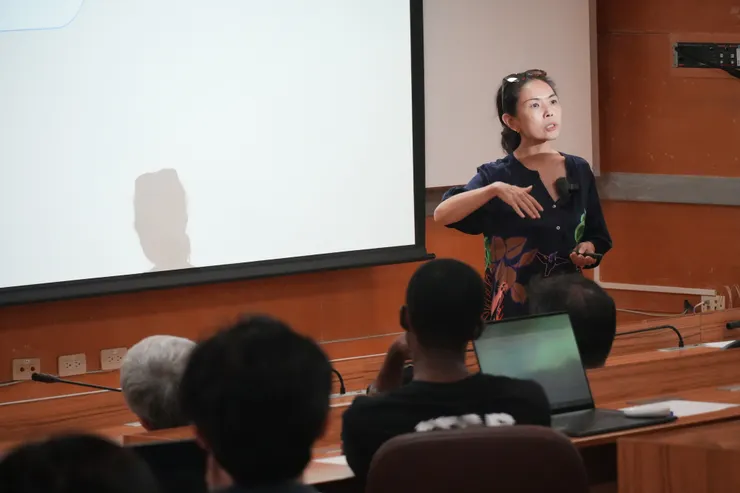
To solidify these concepts, the workshop included a hands-on activity. Participants were given paper strips, each describing one of four different common EMI teaching scenarios. Their task was to discuss and select which specific scaffolding strategies—linguistic, cognitive, metacognitive, or socio-emotional—they would apply to support students in that particular situation, making the theoretical framework immediately practical.
Conclusion: Teaching is Designing, Not Delivering
The challenges of EMI are real, but as the speaker concluded, "Teaching is not just delivering content; it is designing conditions for learning." Scaffolding is not an "extra." It is the bridge that turns EMI into learning for all. When we scaffold well, we lower barriers, we invite every voice, and we design pathways for growth for every student, not just some.
陳玠妤 博士後研究員 (Postdoctoral Research Fellow)
雙語教育推動辦公室 (Office of Bilingual Education Initiatives)
國立臺灣科技大學 (National Taiwan University of Science and Technology)