In modern precast concrete production, efficiency is no longer just about faster casting or more molds—it is about how quickly, safely, and precisely materials move through every stage of production. From casting beds to curing zones, from demolding to storage and dispatch, material flow determines whether a precast yard runs at full capacity or constantly struggles with bottlenecks.
Among all lifting equipment used in precast facilities, the 20 ton overhead crane stands out as one of the most effective solutions for medium to large-scale production lines. Properly designed and operated, it can significantly improve workflow continuity and, in many cases, double overall yard productivity compared to manual handling or undersized lifting systems.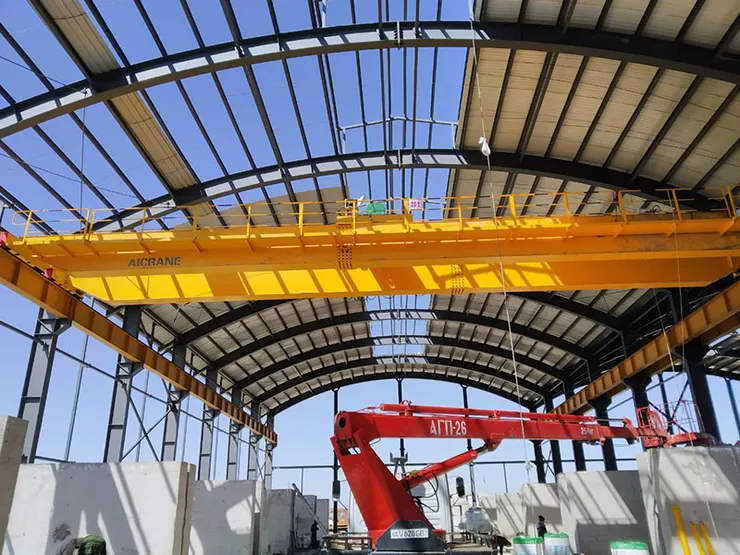
1. The Role of a 20 Ton Overhead Crane in Precast Production
A precast yard is a continuous production environment where heavy concrete elements—such as wall panels, beams, slabs, and columns—must be moved repeatedly throughout the day. These elements often weigh between 5 and 20 tons, making a 20 ton overhead crane a perfect match for typical production demands.
According to industry practices, overhead cranes in precast plants are widely used for frequent lifting cycles, precise mold positioning, and fast transfer of components between production stages .
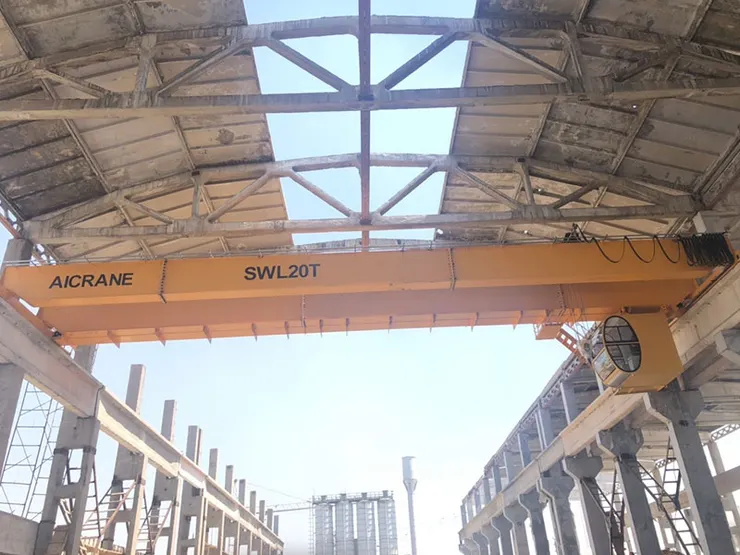
Unlike gantry cranes that operate in open yards, overhead cranes run on runway beams inside workshops, allowing them to:
- Cover the entire production line
- Avoid ground-level obstructions
- Work continuously within tight indoor layouts
- Provide high-precision positioning for molds and products
This makes them the backbone of indoor precast operations.
2. Eliminating Production Bottlenecks Between Key Stages
One of the biggest productivity killers in precast yards is waiting time between production stages. Without efficient cranes, molds and precast elements often sit idle while workers wait for lifting equipment.
A 20 ton overhead crane removes this limitation by ensuring smooth transitions between:
- Steel reinforcement placement → casting bed
- Casting → curing zone
- Demolding → finishing area
- Storage → loading zone
Fast and accurate mold handling directly improves cycle time, which is critical in high-output precast manufacturing .
When every stage flows without delay, the entire production line becomes synchronized—similar to an assembly line in automotive manufacturing.
3. Increasing Lifting Frequency and Cycle Speed
In precast yards, productivity is not just about lifting capacity—it is about how many lifting cycles can be completed per hour or per shift.
A properly selected 20 ton overhead crane enables:
- Rapid hook positioning over molds
- Smooth horizontal travel between stations
- Reduced waiting time for rigging and alignment
- Faster unloading and stacking of finished elements
Even small improvements in cycle time (for example, saving 2–3 minutes per lift) can translate into dozens of additional lifts per day. Over a full production shift, this creates a significant increase in throughput.
This is one of the key reasons overhead cranes are considered essential for high-capacity precast plants—they directly influence output per hour, not just lifting strength.
4. Supporting Simultaneous Production Workflows
Modern precast plants rarely operate in a single linear process. Instead, multiple workflows happen simultaneously:
- Casting in one zone
- Curing in another
- Demolding in a third
- Storage and dispatch in outdoor yards
A 20 ton overhead crane helps connect these parallel workflows by acting as a central material handling hub.
As highlighted in precast industry analysis, efficient crane systems enable plants to move multiple elements across different production stages without interruption, significantly improving throughput and reducing idle time .
This parallel workflow structure is one of the main reasons precast construction is faster than traditional site-cast methods.
5. Precision Handling Reduces Rework and Material Waste
Another hidden factor that affects productivity is product damage and rework. Poor lifting precision can cause:
- Chipped edges on precast panels
- Misalignment during mold placement
- Surface damage during stacking
- Unsafe handling of large elements
A 20 ton overhead crane improves precision through:
- Stable lifting with minimal sway
- Accurate positioning control
- Smooth acceleration and braking
- Operator-controlled fine movement
Better accuracy means fewer damaged components, which directly improves productivity because fewer units need to be repaired or discarded.
In precast manufacturing, even a small reduction in defect rate can translate into substantial time and cost savings over a production cycle.
6. Enabling Multi-Shift High-Volume Production
High-output precast yards typically operate in one or two shifts per day. The goal is simple: maximize output from existing molds, labor, and curing space.
A 20 ton overhead crane supports this goal by:
- Reducing manual handling requirements
- Minimizing downtime between lifts
- Maintaining stable workflow across shifts
- Allowing continuous mold reuse
Because cranes handle repetitive lifting tasks quickly and reliably, workers can focus on preparation, quality control, and finishing tasks instead of heavy physical movement.
This redistribution of labor increases overall plant efficiency and reduces operational fatigue.
7. Improving Safety While Increasing Speed
Many people assume that faster production increases risk—but with modern overhead cranes, the opposite is often true.
A 20 ton overhead crane improves safety by:
- Eliminating manual lifting of heavy loads
- Reducing forklift congestion in production zones
- Preventing uncontrolled movement of large precast elements
- Ensuring controlled, guided load transfer
Safety improvements directly support productivity because fewer accidents, delays, and equipment damage events occur. In industrial environments, safety and efficiency are tightly connected.
8. Optimizing Space Utilization in Precast Yards
Precast production facilities often face space constraints. Casting beds, curing zones, reinforcement storage, and finished goods areas must all fit into a limited footprint.
Overhead cranes help optimize space because:
- They operate above ground level
- No floor space is required for travel paths
- Materials can be stacked more efficiently
- Production zones can be placed closer together
This compact workflow layout reduces movement distances and improves overall handling speed.
9. Real Productivity Impact: Why Output Can Double
When all the above factors are combined, the productivity gains become significant:
- Faster cycle times
- Reduced idle waiting
- Fewer damaged components
- Better workflow synchronization
- Higher lifting frequency
- Reduced labor inefficiency
In many real-world precast operations, upgrading to a properly configured 20 ton overhead crane system leads to:
- 30–50% faster production cycles
- Significant reduction in downtime
- Up to 2× increase in daily output capacity under optimized conditions
This “doubling effect” is not from lifting power alone—it comes from system-wide workflow optimization enabled by reliable, high-frequency material handling.
Conclusion
A 20 ton overhead crane is far more than a lifting machine—it is a production accelerator for precast yards. By improving material flow, reducing bottlenecks, enhancing precision, and enabling continuous multi-stage workflows, it transforms how precast facilities operate.
In today’s competitive construction environment, where speed and quality must coexist, investing in a well-designed overhead crane system is one of the most effective ways to scale production capacity without expanding physical space.
For precast manufacturers aiming to increase output, reduce delays, and improve operational stability, the 20 ton overhead crane is not just an equipment upgrade—it is a strategic productivity multiplier.